
- Disputes
- Commercial & Contract Disputes
- Company & Shareholder Disputes
- Construction Disputes
- Contentious Trusts & Probate
- Energy and Oil & Gas Disputes
- Injunctions & Emergency Interim Relief
- Financial Services Disputes
- Fraud & Asset Tracing
- Intellectual Property & Technology Disputes
- International Litigation & Arbitration
- Judicial Review
- Mediation & Other ADR
- Real Estate Disputes
- Public Procurement Challenges
- Tax Disputes

Private Wealth by Greenwoods is for those who care deeply about protecting not just their financial wellbeing, but the people and values they cherish most. We bring clarity to complexity, ensuring every decision supports the life you lead and the legacy you leave.
Our mission is to demystify wealth, to educate with empathy, and to support families through life’s key moments, from building a legacy to preserving it for generations to come.
Commercial
- Disputes
- Commercial & Contract Disputes
- Company & Shareholder Disputes
- Construction Disputes
- Contentious Trusts & Probate
- Energy and Oil & Gas Disputes
- Injunctions & Emergency Interim Relief
- Financial Services Disputes
- Fraud & Asset Tracing
- Intellectual Property & Technology Disputes
- International Litigation & Arbitration
- Judicial Review
- Mediation & Other ADR
- Real Estate Disputes
- Public Procurement Challenges
- Tax Disputes
Private Wealth by Greenwoods is for those who care deeply about protecting not just their financial wellbeing, but the people and values they cherish most. We bring clarity to complexity, ensuring every decision supports the life you lead and the legacy you leave.
Our mission is to demystify wealth, to educate with empathy, and to support families through life’s key moments, from building a legacy to preserving it for generations to come.

Home // Insights & Events // Companies House reforms: what you need to know about compliance and enforcement
Companies House reforms: what you need to know about compliance and enforcement
The 26 October 2025 marked two years since the Economic Crime and Corporate Transparency Act 2023 (ECCTA) received Royal Assent. Even after extensive coverage, its sweeping reforms continue to matter for those responsible for running UK companies—directors and officers alike.
From 18 November 2025, Companies House introduced mandatory identity verification for all Persons with Significant Control (PSCs), Directors, members of LLPs, general partners of limited partnerships, and relevant officers of Registrable legal entities (RLEs). This marks the start of a 12-month transition period for existing directors and PSCs to comply.
To support the public, on 17 November 2025, Companies House issued guidance on non-compliance with the mandatory identity verification requirements [1].
This article explains:
- how the identity verification process works;
- who needs to comply and by when; and
- what enforcement measures for non-compliance are listed under the Companies House 17 November guidance [2].
Identity verification process
Verification can be completed in two ways:
- Via the government portal GOV.UK One Login.
- Through an Authorised Corporate Service Provider (ACSP).
Once verified, individuals receive a unique personal code. This code is essential for future filings and should be kept secure. What is important is that there is only one code required for an officer who holds positions in various UK companies as a Director/Member of LLP/general partner/PSC or someone acting on behalf of an RLE.
Complying with the verification requirement – timeframes
The rules differ depending on whether you are a new or existing director or PSC. From 18 November:
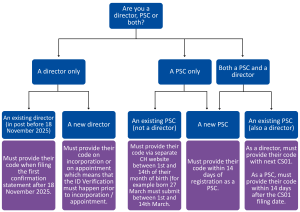
Please find the link to the PSC Companies House website here.
Enforcement measures
Companies House guidance adopts both supportive and punitive approaches:
Supportive measures
Companies are encouraged to comply with the requirement voluntarily. To that end, companies can receive support and advice from the Companies House helpline. Companies House is running an information campaign to raise awareness of the requirements, which may include sending emails and letters directly to companies.
Punitive measures
We have yet to see Companies House in action, however, generally, Companies House can enforce compliance through prosecution, referral to the Insolvency Service and apply financial penalties (para 5.1). While deciding whether non-compliance merits a punitive action, Companies House is likely to consider a wide range of factors. The guidance states that if a person or company has committed three or more offences over the five-year period, their failure is likely to be considered serious (para 5.3). The enforcement action might be paused for up to two months if mitigating circumstances are presented (para 6). Companies House can also annotate the public register (para 5.6) – diminishing public trust in the company or even disqualifying the director if they continue to act without verification (para 5.4).
Conclusions
Identity verification is now a legal requirement for all officers of a company. Whether you are a newly appointed Director or have acted as one for years, this requirement must be complied with. Non-compliance will result in serious consequences, including criminal liability and reputational damage.
The safest approach is to act promptly and ensure your details are verified. Contact our Company Secretarial team if you need assistance.
[1] [2] Companies House approach to non-compliance with mandatory identity verification – GOV.UK
Provide identity verification details for a person with significant control (PSC) – GOV.UK
Do you need an ACSP to help verify your identity?
Greenwoods are now an ACSP and can support you on your ID&V journey with a simple and efficient process.
Please find out more here: Simplifying your ID&V journey
Related articles
This update is for general purposes and guidance only and does not constitute legal or professional advice. You should seek legal advice before relying on its content. Greenwoods Legal Services Limited is a Limited company, registered in England, registered number 16115882. Our registered office is Queens House, 55-56 Lincoln’s Inn Fields, London, WC2A 3LJ. Authorised and regulated by the Solicitors Regulation Authority, SRA number 8011813. Details of the Solicitors’ Codes of Conduct can be found at www.sra.org.uk. All instructions accepted by Greenwoods Legal Services Limited are subject to our current Terms of Business. VAT Reg No: 502 6933 06
Get in touch with us (*Required fields)
Sign up to updates (*Required fields)